The advice to turn the thermostat down at night and while you’re at work is correct for some heating systems and costly for others. A furnace answers a setback in minutes. A cast iron radiator system answers it in hours. A heat pump can answer it by switching on the most expensive heat in the house. Pittsburgh has furnaces and boilers by the block and a growing number of heat pumps, and the setting that saves money in one basement wastes it in the next.
Furnace Homes: Where Setbacks Pay Off
A forced-air furnace heats air quickly and has little thermal mass to warm up, so it recovers fast. The U.S. Department of Energy says you can save as much as 10 percent a year on heating and cooling by turning the thermostat down 7 to 10 degrees for eight hours a day in the fall and winter. The savings come from physics: a house loses heat in proportion to the difference between inside and outside temperature, so a cooler house over eight hours loses less.
Older Pittsburgh houses with leaky windows, uninsulated walls, and drafty basements cool off faster than tight modern homes, which means a deep setback can leave the house uncomfortably cold well before morning and takes longer to recover from. A more modest setback of five or six degrees often gives a good share of the savings without the chill. Setting the schedule to start recovering 30 to 45 minutes before you wake is easier on the system than a single large jump at 6 a.m.
Radiator and Baseboard Homes: Slow Response Changes the Rules
A hot water system moves heat differently. The boiler warms a large volume of water, the water warms the radiators, and the radiators warm the room, with each step adding delay. A cast iron radiator holds a lot of heat and gives it up slowly, which is why these systems feel so even and also why they recover from a setback slowly. A 10-degree drop overnight can take several hours to climb back, and the boiler often runs its hottest water to catch up.
For a boiler with outdoor reset or a condensing model, the most efficient way to heat is to run cooler water for long stretches. Aggressive setbacks work against that. Small setbacks, two to four degrees, or a thermostat that learns how long the house takes to recover and starts early, fit this kind of system better. Setback recovery is where a boiler’s reset and boost controls come into play, which is a good reason to ask how a new thermostat will interact with the boiler’s controls before it goes on the wall.
Compatibility is the other issue with older hydronic systems. Zone valves, circulators, and older boilers use different wiring, and some thermostats that work on a furnace won’t run a boiler at all. Older gas boilers are often millivolt systems, which most smart thermostats cannot run. Many Wi-Fi thermostats also need a common wire that older houses never ran to the wall. A technician can add one, or choose a model that works without it.
Heat Pump Homes: The Setback That Backfires
A heat pump heats efficiently by moving heat from outdoor air, and it does that slowly and steadily. When the thermostat asks for a big jump in the morning, the heat pump can’t deliver it fast enough, and the thermostat calls for backup electric resistance heat to close the gap. That backup heat costs far more to run than the heat pump itself. The Department of Energy warns against setting a heat pump thermostat back by hand if doing so brings on backup resistance heating, and recommends a smart or programmable thermostat designed for heat pumps.
In practice, this means smaller setbacks, two or three degrees, and a thermostat that stages the backup heat sensibly and holds it off until the heat pump has had its chance. A homeowner choosing among heat pump options should confirm the thermostat is designed for one. Leave the system selector on its normal heat setting. The “emergency heat” setting runs the backup strips continuously and belongs only to a time when the outdoor unit has failed.
Why the Thermostat Reads the Wrong Temperature
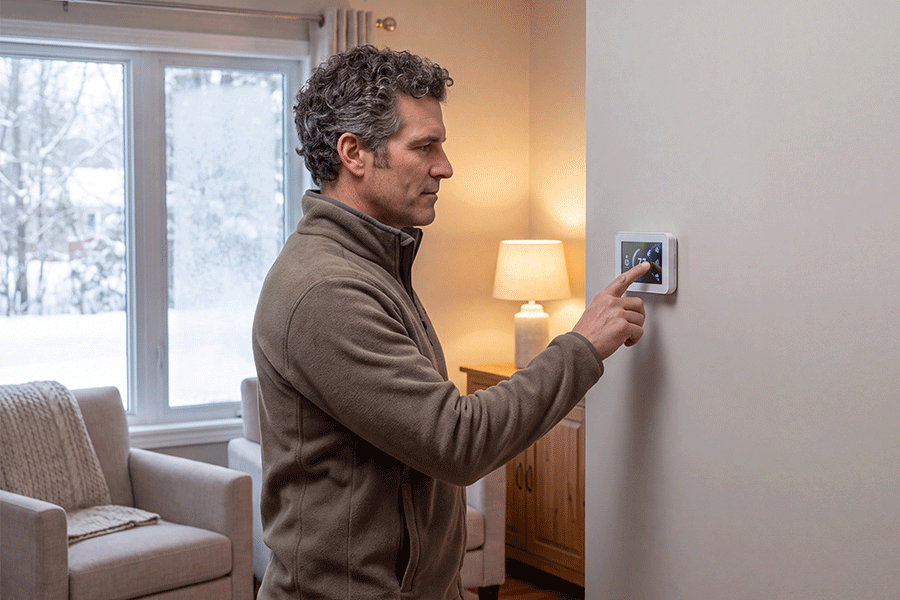
A thermostat controls the temperature at one spot, and the spot matters. One mounted on an exterior wall, near a draft, in direct sun, or above a radiator reads colder or warmer than the room, and the system runs to fix a number that isn’t real. A hallway wall away from vents, windows, and kitchen heat is the usual choice.
Sometimes the thermostat reads fine, and the house still won’t agree with it. When the upstairs never matches the downstairs, or a finished basement runs cold while the bedrooms run warm, one thermostat can’t solve it, and zone control splits the house so each area is heated to its own setting.
Signs the Thermostat Itself Is the Problem
Some trouble is in the control, not the heating equipment. A house that never reaches the number on the display, a system that won’t turn on or off when it should, a unit that short cycles, or a blank or frozen screen all point to the thermostat. Often it can be recalibrated or repaired, and sometimes it should be replaced. For a house that has gone through several equipment changes, thermostat installation and repair gets the control matched to what it now runs.
Smart or Programmable, and What to Do When You’re Away
A programmable thermostat follows a schedule and costs less. A smart thermostat adds learning, remote control, and energy reports, and ENERGY STAR certified models are verified for savings. For a household that travels over the holidays, the remote controls are useful. Whatever the model, don’t let the temperature fall below about 55 degrees when the house is empty during a cold snap, since pipes along exterior walls are the first thing to freeze.
Matching the Thermostat to the Heating System Before the Coldest Weeks
The coldest weeks of the Pittsburgh winter still lie ahead, and the settings that look sensible on the display can cost the most. A technician who looks at the equipment, the wiring, and the thermostat location can set up a schedule that suits the system in the basement.
To make sure your thermostat is right for your heating system, ask Boehmer Heating & Cooling about a thermostat upgrade or call 412-381-4100 today!